


By Amah Alphonsus Amaonye, Director General, African Writers Centre, AWC
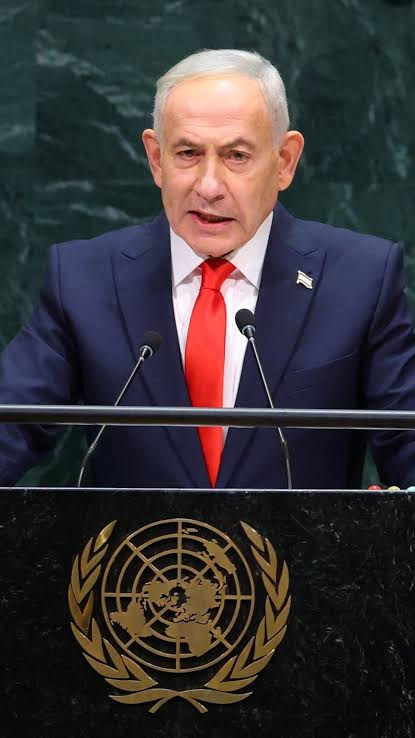
In one of the most personal and emotionally charged moments of his address to the United Nations General Assembly on Thursday, Israeli Prime Minister Benjamin Netanyahu turned away from the immediate battles of the Middle East and reached deep into his family’s history — invoking the memory of his younger brother, Jonathan “Yoni” Netanyahu, the Israeli commander killed while leading the 1976 Entebbe hostage-rescue operation in Uganda.
The moment transformed an otherwise combative geopolitical speech into a deeply personal narrative about sacrifice, survival, duty and national resolve.
Netanyahu was addressing the 81st session of the UN General Assembly in New York, where his appearance was accompanied by a major diplomatic confrontation: numerous delegates walked out as he approached the podium. Netanyahu responded by telling those who remained that if there were any other “moral cowards” in the hall, they should leave as well.
But beneath the confrontation was another message — one rooted not in diplomacy but in memory.
THE BROTHER WHO BECAME A NATIONAL SYMBOL
Netanyahu took the assembly back to June 1967, before the Six-Day War.
He recalled himself as a teenager returning from Philadelphia to Israel as the country prepared for war. Israel, he said, was in blackout and preparing for what appeared to be an existential confrontation.
His brother Yoni was then a 21-year-old paratrooper officer whose unit had already been mobilised.
Netanyahu said he went to see Yoni and asked him what was going to happen.
The answer, as Netanyahu recalled it decades later, was stark:
“We’re going to win. We have no other choice.”
It was this sentence that became the emotional spine of the speech.
Nine years later, Yoni would become one of the best-known figures in Israeli military history.
ENTEBBE: THE MISSION THAT COST YONI HIS LIFE
In 1976, an Air France aircraft was hijacked and diverted to Entebbe Airport in Uganda, where Israeli and other passengers were held hostage.
Israel launched a long-range military operation to rescue the hostages.
Yoni Netanyahu, by then a commander in Israel’s elite Sayeret Matkal special forces unit, led the assault.
The operation succeeded in rescuing the majority of the hostages.
But Yoni was killed during the assault.
He was the only Israeli soldier killed during the rescue operation, although several hostages also died in the wider episode. The operation subsequently became known as Operation Entebbe or Operation Yonatan, in his memory.
At a state ceremony marking 50 years since the operation earlier this year, Israel’s President Isaac Herzog and Netanyahu again recalled Yoni’s role, while Israeli military leaders described the operation as a defining episode in the country’s military history.
And on Thursday, before the world’s diplomatic audience, Netanyahu brought his brother’s voice back to the centre of Israel’s national story.
“YONI’S WORDS ARE AS TRUE TODAY…”
The most powerful part of Netanyahu’s remembrance was not merely the story of Yoni’s death.
It was the way the Prime Minister connected his brother’s words in 1967 to Israel’s current circumstances.
After recounting Yoni’s role in Entebbe, Netanyahu told the assembly that his brother’s words remain relevant.
“Yoni’s words are as true today as they were half a century ago,” he said, before repeating the refrain:
“We’re going to win. We have no other choice.”
That repetition gave the speech its emotional architecture.
The first time, the words belonged to a 21-year-old soldier facing an uncertain war.
The second time, they were being spoken by his younger brother more than half a century later, now as Israel’s Prime Minister, in the middle of another prolonged regional conflict.
The effect was unmistakably personal.
FROM FAMILY MEMORY TO NATIONAL DOCTRINE
Netanyahu’s speech used Yoni’s story to make a broader argument about how Israel understands national survival.
His narrative was essentially this:
Threat → choice → action → sacrifice → survival.
The Prime Minister presented Israel’s history as a succession of moments in which the country was confronted with threats it regarded as existential and was forced, in his telling, to act because there was no alternative.
He used that framework to defend Israel’s military campaign against Iran and its wider confrontation with armed groups across the region.
Netanyahu described Israel as fighting what he called a “seven-front war”, beginning with the Hamas attack of October 7, 2023, and extending to Hezbollah, the Houthis, Iranian forces and allied groups.
He argued that Israel’s military actions were fundamentally acts of self-defence.
That interpretation is fiercely contested internationally, particularly over Israel’s conduct in Gaza and the humanitarian consequences of the war. Israel rejects allegations that it has committed genocide or deliberately targeted civilians. Palestinian officials and other governments have made opposing allegations concerning Israel’s military conduct.
THE IRAN MESSAGE
Another major pillar of the speech was Iran.
Netanyahu defended Israel’s attacks on Iranian nuclear facilities, describing the decision to strike Iran as among the easiest decisions he had made as Prime Minister because, in his argument, allowing Iran to develop nuclear weapons would have posed an existential threat.
He also presented Israel’s military campaign as protecting not only Israel but other countries threatened by the conflict.
His speech therefore had two audiences: the delegates inside the UN chamber and the Israeli public watching from home.
THE WALKOUT — AND THE COUNTERATTACK
The speech began amid a dramatic visual confrontation.
Large numbers of delegates walked out when Netanyahu took the podium, leaving substantial sections of the General Assembly hall empty.
Rather than ignore the walkout, Netanyahu immediately confronted it.
He called on anyone else who wanted to leave to do so.
The Palestinian Mission had urged countries beforehand to stage a collective walkout in protest against Israel’s conduct in Gaza and its occupation policies. Israel rejects the accusations directed at its government.
Netanyahu then proceeded with an unusually combative defence of Israel, attacking what he described as international hypocrisy and double standards.
A SPEECH BUILT AROUND “CHOICE”
Perhaps the most important rhetorical feature of Netanyahu’s address was the repeated use of the language of choice and necessity.
Israel, in his presentation, was not choosing war for its own sake.
It was responding to threats.
That argument appeared repeatedly — from Iran and nuclear weapons to Hamas, the October 7 attack, Hezbollah and other regional actors.
The Yoni story gave that argument a human face.
Instead of presenting military necessity solely through statistics, weapons and strategic maps, Netanyahu presented it through the memory of a 21-year-old brother who had once told him that victory was necessary because there was no alternative.
That is why the Entebbe passage stood apart from the rest of the address.
It was not simply about Iran.
It was not simply about Gaza.
It was about memory.
It was about a brother.
And it was about how the memory of one fallen soldier has become woven into Israel’s national understanding of courage and responsibility.
FROM ENTEBBE TO TODAY
The connection between Entebbe and today’s Middle East war is not merely Netanyahu’s creation.
Earlier this year, at the 50th-anniversary ceremony of Operation Entebbe, Netanyahu said that he thinks about Yoni every day and described the spirit of Entebbe as continuing to influence Israeli soldiers.
The Israeli military leadership has likewise presented Entebbe as part of a continuing tradition of hostage-rescue operations.
But Netanyahu’s use of the story at the UN carried a particular weight.
He was standing before a global institution deeply divided over Israel’s war.
He had just watched delegations leave the chamber.
He was defending his government’s military decisions.
And then he invoked the brother who died leading Israeli soldiers into Uganda nearly five decades ago.
The transition was deliberate:
From the battlefield of 1967, to Entebbe in 1976, to the conflicts of 2026.
THE FINAL MESSAGE
Netanyahu ended the speech by returning to the same phrase that had emerged from his brother’s memory:
“We have no other choice.”
The Times of Israel reported that the Prime Minister concluded with that refrain and received about 30 seconds of applause from the gallery.
Whatever one’s political position on Israel, Palestine, Iran or the wider Middle East conflict, the rhetorical significance of the Yoni passage is difficult to miss.
Netanyahu converted a family memory into a national metaphor.
Yoni’s life and death became, in his telling, a bridge between generations — from a young paratrooper preparing for war in 1967, to the commander of the Entebbe rescue mission, to a Prime Minister standing before the United Nations nearly 50 years later.
It was the most human part of a speech otherwise dominated by war, weapons, diplomacy and accusation.
And the final message was unmistakably the one Netanyahu wanted the world to hear:
Israel, he argued, believes its survival requires resolve — and that surrender is not an option.
The power of the speech lay not merely in the volume of Netanyahu’s words, but in the personal history behind them.
A younger brother remembered an older brother.
A soldier remembered a commander.
A nation remembered a fallen son.
And before the world’s most important diplomatic assembly, Netanyahu brought Yoni’s 1967 words into 2026:
“We’re going to win. We have no other choice.”
#Netanyahu #YoniNetanyahu #Israel #UNGA2026 #Entebbe


