


By Amah Alphonsus Amaonye, Director General, African Writers Centre, AWC
Vice President Kashim Shettima has called on Nigerians living abroad to play a more active role in the country’s economic transformation, stressing that their capital, expertise, networks and intellectual capacity represent an important resource for national development.
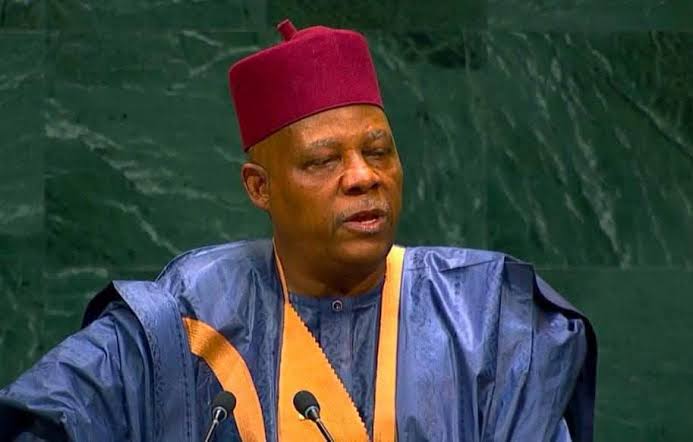
Shettima made the call on Wednesday at Nigeria House in New York, where he held an interactive engagement with members of the Nigerian diaspora in the United States on the sidelines of the 81st United Nations General Assembly.
The meeting, coordinated by the Nigerians in Diaspora Commission (NiDCOM), focused on ways Nigerians abroad can contribute to national development through investment, skills transfer, innovation and stronger economic and diplomatic connections between Nigeria and the wider world.
The Vice President described the diaspora community as “the greatest resource of the future”, arguing that Nigerians possess the skills and intellectual capacity required to unlock the country’s enormous potential.
“Citizens of our country have the capacity and intellect to harness our nation’s potentials and take it to greater heights,” Shettima said.
FROM REMITTANCES TO INVESTMENT
The engagement goes beyond the traditional role of diaspora Nigerians as remittance senders.
The Federal Government is seeking to deepen the relationship by encouraging Nigerians abroad to participate directly in productive investment, technology, education, healthcare, agriculture and other sectors capable of expanding Nigeria’s economic base.
Shettima said the administration was working to reposition the economy while leveraging Nigerians abroad in areas including education, health, science and technology and agriculture.
The Vice President’s appeal also comes against the background of the enormous economic contribution of Nigerians living outside the country.
At the 2026 World Economic Forum, Shettima said Africans abroad sent home about $95 billion in 2024, describing the flow as roughly equivalent to total foreign direct investment into Africa.
For Nigeria, the challenge is increasingly how to convert diaspora financial flows into longer-term investment, entrepreneurship, technology transfer and institutional partnerships.
“NIGERIA IS OPEN FOR BUSINESS”
Shettima also sought to counter what he described as negative narratives about Nigeria circulating on social media.
“Beyond the negative stories that you hear and see in the social media, Nigeria is open for business,” the Vice President told the gathering.
He said the country had crossed what he described as a critical point in its economic adjustment and was on a path toward sustained growth.
The statement forms part of the government’s broader effort to attract investment and present Nigeria as a destination for international capital and business.
REFORMS AND HUMAN CAPITAL
Shettima also highlighted government programmes in education and human capital development.
He cited the Nigeria Education Loan Fund, saying that more than 1.29 million Nigerian students in tertiary institutions had accessed about ₦125 billion through the programme since its commencement.
His message to the diaspora was therefore built around partnership: Nigerians outside the country are not merely observers of developments at home but can contribute knowledge, capital, technology, professional networks and international experience.
A DIASPORA WITH A STRATEGIC ROLE
The New York engagement also fits into Nigeria’s wider diplomatic agenda at the UN General Assembly.
Shettima is representing President Bola Ahmed Tinubu and leading Nigeria’s delegation to the 81st UNGA, where Nigeria has been advocating stronger representation for developing countries and reforms of global institutions.
The Vice President has said Nigeria’s participation in the UNGA will be guided by national interest, multilateral cooperation and the pursuit of a more representative international system.
The diaspora engagement consequently places Nigerians abroad within that wider national-interest framework.
They constitute a global network of professionals, entrepreneurs, academics, investors and innovators who can potentially connect Nigeria to markets, technologies and institutions around the world.
THE AWC PERSPECTIVE
The significance of the New York conversation lies in one simple proposition: Nigeria’s human capital does not stop at its borders.
Millions of Nigerians living, working and studying abroad remain connected to the country through family, business, professional networks and cultural ties.
The policy challenge is how to transform that connection into structured national development.
That requires more than appeals for patriotism. It requires predictable investment rules, transparent institutions, mechanisms for technology transfer, diaspora investment vehicles, protection of intellectual property and a business environment capable of attracting Nigerians who have built careers and businesses overseas.
If those conditions are strengthened, the Nigerian diaspora can become not only a source of remittances but a significant bridge between Nigerian talent and global capital.
From New York, Shettima’s message was therefore clear: Nigeria wants its citizens abroad to participate more directly in building the country.
And for a nation seeking to transform its economic fortunes, the Nigerians who left may yet become an important part of building what they left behind.
#Nigeria #Shettima #NigeriansInDiaspora #UNGA81 #EconomicDevelopment


