


By Amah Alphonsus Amaonye, Director General, African Writers Centre, AWC.
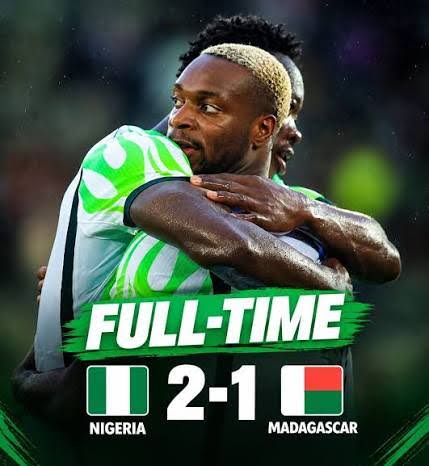
UYO — The Super Eagles of Nigeria survived an uncomfortable opening-night scare in their 2027 Africa Cup of Nations qualifying campaign, coming from behind to defeat Madagascar 2–1 at the Godswill Akpabio Stadium, Uyo, on Friday.
But while the comeback delivered the three points Nigeria desperately needed, the narrow victory also exposed the pressure surrounding the Eagles’ qualification campaign.
Madagascar stunned the home crowd in the 15th minute when Ehsan Kari put the visitors ahead. Nigeria eventually restored parity through debutant George Ilenikhena in first-half stoppage time before another debutant, Moses Usor, completed the comeback in the 65th minute.
It was therefore a case of Nigeria escaping from a potentially damaging position rather than cruising to victory.
A NARROW ESCAPE THAT COULD HAVE BEEN COSTLY
The early Madagascar goal immediately increased the tension in Uyo.
For a team entering the competition under considerable pressure following Nigeria’s failure to qualify for the 2026 FIFA World Cup, falling behind at home against Madagascar was precisely the kind of start the Super Eagles needed to avoid.
Madagascar had already demonstrated that they could trouble Nigeria. They famously defeated the Super Eagles 2–0 at the 2019 AFCON in Egypt, when they reached the quarter-finals. The opening goal in Uyo therefore carried an uncomfortable historical reminder.
This time, however, Nigeria found a response.
Ilenikhena’s equaliser shortly before the interval prevented the Eagles from going into the dressing room behind, while Usor’s second-half strike finally turned the game around.
The two debutants consequently became the unlikely architects of Nigeria’s first three points.
GROUP L: THERE IS NO ROOM FOR COMPLACENCY
The victory becomes even more important when the structure of Group L is examined.
Nigeria were drawn alongside Madagascar, Guinea-Bissau and Tanzania. But Tanzania are one of the three hosts of the 2027 AFCON, alongside Kenya and Uganda, and are therefore already guaranteed a place at the finals.
Consequently, CAF’s qualification arrangement means that only the highest-ranked team among Nigeria, Guinea-Bissau and Madagascar will qualify from Group L.
That makes Group L fundamentally different from most other qualifying groups, where the first two teams generally qualify.
In practical terms, Nigeria are in a three-team race for one ticket.
GUINEA-BISSAU TAKE EARLY ADVANTAGE
The other Group L match produced a result that immediately altered the complexion of the group.
Guinea-Bissau defeated Tanzania 2–0 away from home, giving the Djurtus three points and a superior goal difference to Nigeria after the opening round.
The early table therefore puts:
1. Guinea-Bissau — 3 points, +2 goal difference
2. Nigeria — 3 points, +1 goal difference
3. Madagascar — 0 points
4. Tanzania — 0 points
However, Tanzania’s zero points do not carry the same significance as those of the other teams because the co-hosts are already qualified for the tournament.
So, beneath the surface, the real Group L table is effectively a contest between Nigeria, Guinea-Bissau and Madagascar for one qualification position.
NEXT STOP: GUINEA-BISSAU
And this is where Nigeria’s 2–1 victory assumes even greater importance.
The Super Eagles’ next Group L assignment is away to Guinea-Bissau on Tuesday, September 29. Guinea-Bissau will enter that encounter having already collected three points and a two-goal advantage from their opening fixture.
Nigeria therefore have very little time to celebrate the Madagascar victory.
The September double-header has effectively created an early test of Nigeria’s ability to compete under pressure. A positive result in Guinea-Bissau would give the Super Eagles valuable momentum and prevent the early standings from becoming more complicated.
The reverse is also true: a poor result would immediately increase the pressure on the Nigerian side.
CHELLE’S SIDE MUST TURN SURVIVAL INTO CONTROL
Coach Éric Chelle can take encouragement from the character displayed by his players.
Going behind and recovering to win demonstrates resilience, and the emergence of Ilenikhena and Usor provides additional attacking options, particularly with Victor Osimhen unavailable for the opening qualifiers because of injury.
But the bigger challenge is consistency.
A qualification campaign is not won by surviving individual matches. Nigeria must accumulate enough points across the six-match home-and-away schedule to finish above both Guinea-Bissau and Madagascar.
CAF’s format gives every team six matchdays, with the decisive ranking determined over the campaign.
THE WARNING FROM UYO
The 2–1 victory should therefore be celebrated, but it should also serve as a warning.
The Super Eagles have opened their campaign with three points, but Guinea-Bissau have opened with three points and a better goal difference.
Nigeria are not in trouble. But neither are they in a position to relax.
The Uyo comeback has kept the Eagles firmly in the race. The next match in Guinea-Bissau could begin to show whether Friday night’s escape was merely a difficult opening night or the beginning of a serious qualification battle.
For now, the mathematics is simple:
Nigeria have won. Guinea-Bissau have also won. Only one of them can ultimately emerge from Group L as the qualifying nation.
And the Super Eagles now know exactly where the road leads next.
Last Line
FROM ONE GOAL DOWN TO THREE POINTS — BUT THE REAL BATTLE HAS JUST BEGUN.
Nigeria survived Madagascar 2–1 in Uyo, but Guinea-Bissau’s 2–0 victory over Tanzania puts the Djurtus top of Group L on goal difference. With only one qualification ticket available among the three non-host contenders, Nigeria’s next battle in Guinea-Bissau could be crucial.
#SuperEagles #AFCON2027 #Nigeria #GuineaBissau #AfricanFootball


