


AWC FOREIGN AFFAIRS DESK
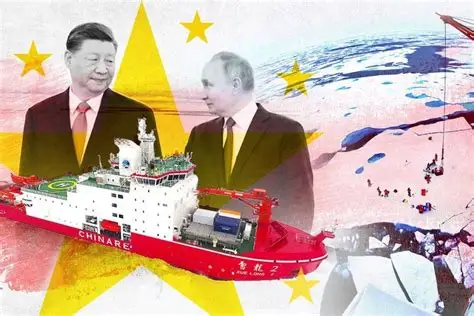
A frozen maritime corridor at the top of the world is emerging as an increasingly important link between China and Russia, reshaping Arctic commerce while giving Moscow a potentially valuable alternative to traditional global shipping routes.
The Northern Sea Route (NSR), which runs along Russia’s Arctic coastline between the Bering Strait and the Barents Sea, has historically been constrained by severe ice conditions and a short navigation season. But improving ice conditions, Russia’s investment in icebreakers and growing Chinese interest are gradually giving the route greater commercial and geopolitical significance.
Recent shipping data analysed by CNN and attributed to Norway-based Centre for High North Logistics (CHNL) indicates that since Russia’s full-scale invasion of Ukraine, international transit along the route has become heavily dominated by trade involving China.
China emerges as Russia’s critical Arctic trading partner
The shift is hardly accidental.
Following the invasion of Ukraine and the subsequent Western sanctions on Russia, Moscow has increasingly redirected energy and commodity exports towards Asian markets. China, with its enormous demand for oil, gas and raw materials and its geographic proximity to Russia’s eastern ports, has become a particularly important destination.
Reuters reported this week that Russia has already sent seven crude-oil shipments totalling about six million barrels through the Northern Sea Route in 2026, almost half the volume transported along the route during the whole of 2025.
The Arctic corridor therefore offers Russia more than a shorter route—it provides another logistical option for maintaining energy exports to Asia amid sanctions, disruptions and geopolitical uncertainty elsewhere.
The route is becoming more than an oil corridor
The significance of the NSR extends beyond Russian hydrocarbons.
China is increasingly positioning itself as an Arctic shipping player. The Financial Times reports that Chinese shipping interests are launching regular container services through the Arctic, with a route connecting China with northern Europe and potentially cutting transit times substantially compared with traditional routes.
This development gives new meaning to China’s long-standing “Polar Silk Road” concept—an Arctic extension of its broader Belt and Road ambitions.
For Beijing, the attraction is straightforward: a northern route can provide an alternative to heavily congested or geopolitically vulnerable maritime chokepoints such as the Suez Canal and Bab el-Mandeb.
Russia supplies the geography; China supplies the commercial demand
The emerging relationship is strategically complementary.
Russia controls the overwhelming majority of the Northern Sea Route and possesses the icebreakers, Arctic ports and logistical infrastructure necessary to operate in the region.
China, meanwhile, provides enormous commercial demand, shipping capacity, capital and a vast consumer and industrial market.
Russia’s development of the route has also accelerated. The 2025 NSR season recorded 103 transit voyages carrying an estimated 3.2 million tonnes of cargo, according to CHNL. However, the organisation cautioned that the route remains a seasonal alternative rather than a replacement for established global shipping arteries.
But the Arctic is not an easy highway
The growing traffic should not be mistaken for the creation of a trouble-free superhighway.
Ice remains the biggest physical challenge. Ships operating on the NSR require appropriate ice-class specifications, specialised navigation expertise and, in many cases, assistance from Russia’s nuclear-powered icebreaker fleet.
There are also limited search-and-rescue facilities, difficult weather conditions and significant environmental risks. The Arctic ecosystem is particularly vulnerable to oil spills and other shipping accidents.
Sanctions create another layer of complexity. Some Russian energy projects and vessels associated with Arctic exports remain subject to Western restrictions, making financing, insurance, vessel availability and international cooperation more complicated.
A geopolitical corridor is taking shape
The growing China-Russia trade relationship in the Arctic is therefore about much more than saving sailing days.
It represents the emergence of a new geopolitical corridor at a time when the Arctic is becoming increasingly important to global powers.
Russia wants the Northern Sea Route to become a commercially viable maritime artery and a source of revenue, strategic influence and access to Asian markets. China wants additional energy supplies and alternative routes into Europe that reduce dependence on traditional maritime chokepoints.
Other countries are beginning to take notice. South Korea, for example, is preparing a trial container voyage through the NSR, while its government and shipping industry explore the possibility of greater participation in Arctic trade.
The bigger picture
The development could eventually alter the geography of global maritime trade—but the transition will not happen overnight.
For now, the Northern Sea Route remains seasonal, specialised and relatively small compared with the Suez Canal and other established global shipping lanes. Yet the direction is unmistakable: more Chinese vessels, more Russian energy cargoes and greater investment are turning a once largely inaccessible Arctic passage into a strategically important commercial corridor.
The deeper implication is that the melting and increasingly navigable Arctic is not merely creating a new shipping route. It is creating a new arena for economic competition, energy security and geopolitical alignment—and China and Russia are moving early to occupy it.
#NorthernSeaRoute #China #Russia #ArcticShipping #GlobalTrade


