


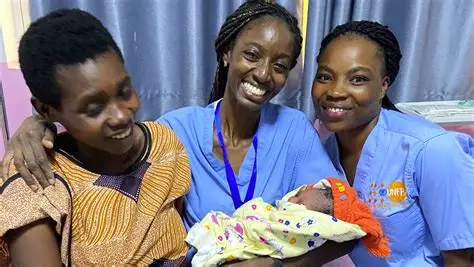
…2.9 million pregnant women and families by 2028
AWC HEALTH DESK, SEPTEMBER 2026
Nigeria has stepped up its battle against preventable maternal and newborn deaths with a renewed national intervention designed to remove financial, social and logistical barriers preventing pregnant women from accessing essential healthcare.
The initiative, launched under the Federal Government’s Maternal and Neonatal Mortality Reduction Innovation Initiative (MAMII), is designed to encourage greater use of antenatal care, skilled delivery and postnatal services.
At the centre of the latest rollout are 215,000 MAMA kits and bags, alongside 40,000 maternal food-support packs and 40,000 sets of essential newborn clothing for vulnerable women and families. The latest distribution follows an earlier rollout of 110,000 MAMA kits in 2025.
The intervention is targeting approximately 2.9 million pregnant women and families by 2028, as the Federal Government seeks to achieve a 30 per cent reduction in maternal mortality and a 20 per cent reduction in newborn mortality within the period.
WHY THE INTERVENTION MATTERS
Nigeria continues to carry an extraordinarily heavy burden of maternal and newborn deaths.
For many women, particularly those living in poor, rural and underserved communities, the problem is not simply whether a health facility exists. The barriers can include transportation costs, the price of basic supplies, inadequate nutrition, distance to health facilities, shortage of trained personnel and weak referral systems.
The new approach therefore seeks to increase demand for care while simultaneously strengthening the systems required to provide that care.
That distinction is critical.
Giving a pregnant woman an incentive to attend antenatal care is only useful if she arrives at a facility where trained personnel, medicines, equipment and emergency referral services are available.
That was also the emphasis from WHO Representative in Nigeria, Dr Pavel Ursu, who called for incentives to be connected with quality care, stronger primary healthcare and referral systems, investment in the health workforce and better use of data to reach populations furthest behind.
BEYOND THE MAMA KIT
The intervention should therefore not be viewed simply as a distribution of bags and supplies.
The Federal Government says MAMII is part of a broader strategy involving emergency obstetric and newborn care, transportation, referral systems and stronger primary healthcare delivery.
This is where the real test lies.
Nigeria has had numerous maternal-health programmes over the years. The challenge has often been translating policy announcements and interventions into consistent, dependable services at the point where a pregnant woman actually needs them.
A woman in a remote community should not have to travel for hours before finding a functioning facility.
A mother experiencing complications should not be lost because an ambulance is unavailable.
A newborn should not die because a health centre lacks trained personnel or basic equipment.
And a woman should not avoid antenatal care simply because she cannot afford the associated costs.
THE ROLE OF STATES
The Federal Government cannot win this battle alone.
Health service delivery is heavily dependent on state and local systems, particularly primary healthcare.
At the launch, Health Minister Muhammad Ali Pate urged state governments to sustain and expand the intervention, stressing that states are closer to communities and can direct resources towards their most pressing health needs.
This is perhaps the most important message from the initiative.
Abuja can launch a programme, but communities must experience the result.
Governors, local government authorities, traditional institutions, religious leaders, health workers and community organisations must therefore become active participants in ensuring that the intervention reaches the women for whom it was designed.
WHO AND DEVELOPMENT PARTNERS
WHO, UNICEF, UNFPA and other development partners are supporting Nigeria’s efforts to improve maternal and newborn survival.
WHO’s contribution extends beyond commodities and incentives to strengthening primary healthcare, workforce capacity and data systems.
That broader systems approach is essential because maternal mortality is rarely caused by one problem.
It is usually the result of several weaknesses converging at the same time — poverty, distance, delayed decision-making, poor transportation, inadequate facilities, shortages of skilled personnel and delayed referrals.
Fixing only one part of the chain will not be enough.
A MATTER OF NATIONAL PRIORITY
The African Writers Centre welcomes the renewed national focus on maternal and newborn survival.
Every maternal death represents not only the loss of a woman but often the destabilisation of an entire family.
Every newborn death is a tragedy that should compel stronger action.
Nigeria therefore needs to move beyond measuring how many kits are distributed to measuring how many women actually receive timely antenatal care, how many deliver with skilled professionals, how quickly emergency cases are referred and, ultimately, how many mothers and babies survive.
That is where accountability must ultimately rest.
The objective should be simple:
Healthy mothers. Healthy newborns. A healthier Nigeria.
And no Nigerian woman should have to risk her life simply because she is poor, lives far from a hospital or cannot afford the cost of accessing basic maternal healthcare.
#MaternalHealth #NewbornHealth #MAMII #HealthForAll #Nigeria


