


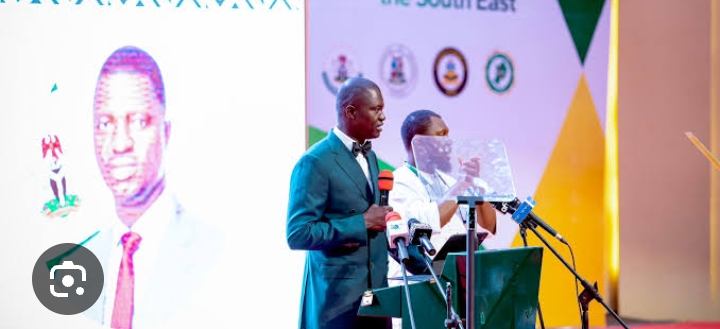
Enugu, February 4, 2026 – His Excellency , Rt Hon Francis Ogbonnaya Nwifuru, the Executive Governor of Ebonyi State has unveiled a bold and comprehensive roadmap for the Southeast’s transformation at the Southeast Development Commission (SEDC) Vision 2050 stakeholders forum in Enugu, emphasizing agriculture, agro-processing, industrialization, and mineral-based development as key drivers of regional growth.
Addressing policymakers, stakeholders, and fellow governors, Nwifuru highlighted the Southeast’s dense human capital, entrepreneurial culture, and abundant natural resources as key strengths for accelerated development, provided structural, policy, and market gaps are addressed.
“The moment calls for a regional compact that aligns agriculture and solid minerals with manufacturing, logistics, and services for the region’s best interest,” Umahi said, stressing strategic coordination across states. He underscored that structural transformation requires moving labor and capital from low-productivity activities to high-productivity manufacturing and modern services, supported by technology adoption, industrial clusters, value addition, and efficient logistics.
Agriculture remains a major employer in the Southeast, engaging 30–40% of the labor force but contributing disproportionately less to GDP due to low productivity and post-harvest losses of 20–45%. Nwifuru highlighted Ebonyi State’s achievements in modernizing agriculture through irrigation projects, rural road networks covering over 2,000 kilometers, revitalized rice mill capacity, and targeted investments in production, storage, and processing. Products like Abakaliki rice are now gaining national recognition.
Expanding beyond agriculture, the Governor outlined the Ebonyi industrial model, featuring ethanol plants, oil refineries, petrochemicals, cold-chain facilities for fruits and vegetables, feed mills, hatcheries, and protein processing plants. The Governor also described major infrastructure projects, including a 210-meter bridge linking Ebonyi State to Oju Local Government Area in Benue, to improve geographic, political, and socio-economic integration.
On solid minerals, Nwifuru emphasized the region’s rich deposits of lead, zinc, limestone, gypsum, salt, granite, and other industrial minerals. Historically extracted informally, these resources will now be developed through structured investments, investor screening, community engagement, environmental standards, and downstream processing. Planned smelting factories and metal fabrication initiatives aim to transform isolated extraction points into regional industrial anchors, generating employment and strengthening local economies.
He also stressed energy diversification, including gas, solar, and power rehabilitation, alongside efficient logistics as critical enablers of regional growth. People-centered development, including dual training programs, apprenticeships, innovation hubs in agritech and material sciences, and dedicated financing for youth- and women-led enterprises, will complement industrialization.
The Governor called for blended finance, development guarantees for SMEs, regional project preparation facilities, and positive regulation to catalyze private investment. Vision 2050, he emphasized, must include measurable targets, transparent dashboards, independent evaluation, and adaptive learning to scale what works.
“Feeding and building the Southeast through agro- and mineral-based industrialization is not an abstract idea. It is achievable, grounded in our land, resources, and people. What we produce must be protected, what we extract must be industrialized, and what we build must be sustained,” Nwifuru concluded.


