


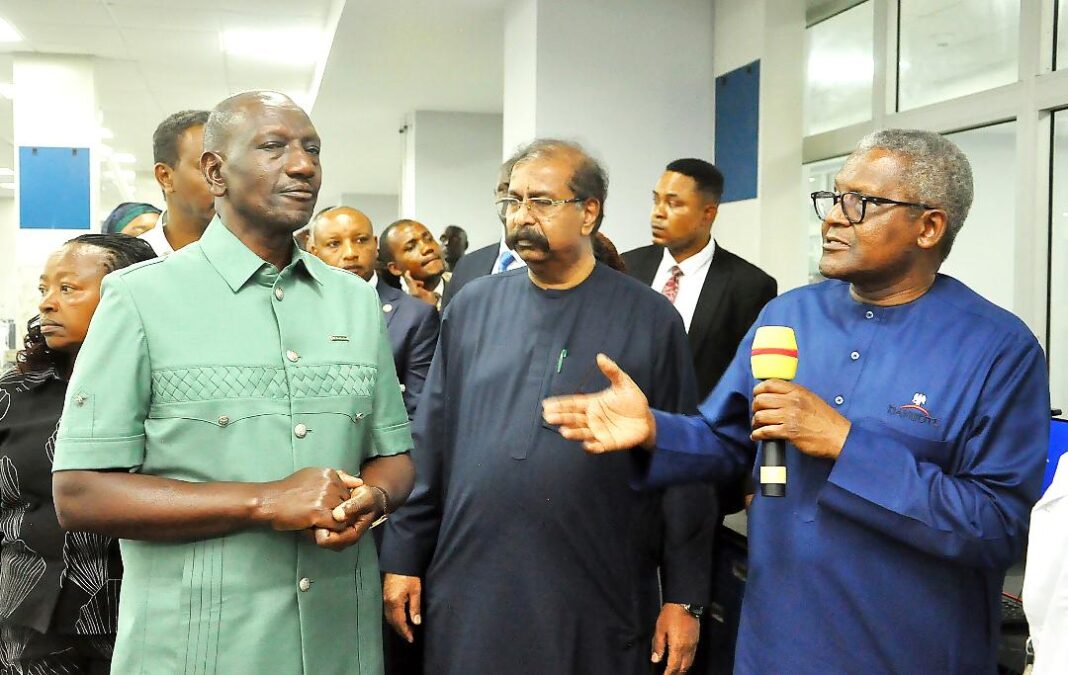
…Kenyan President inspects Nigeria’s 700,000bpd industrial giant ahead of Lamu groundbreaking — but absence of formal Nigerian state reception raises an important question about the nature of the visit
By Amah Alphonsus Amaonye, Director General, African Writers Centre, AWC
LAGOS — Kenyan President William Ruto’s recent visit to the Dangote Petroleum Refinery in Lagos was much more than a sightseeing tour of Africa’s largest single-train refinery.
Coming just days before Kenya is scheduled to break ground on a proposed 700,000-barrel-per-day refinery in Lamu, the visit gave the Kenyan leader an opportunity to see, first-hand, the industrial model that Nigerian businessman Aliko Dangote is seeking to reproduce — and expand — in East Africa.
But the visit also raises an interesting diplomatic question: Was Ruto in Nigeria as a state guest of the Federal Republic of Nigeria, or principally as a guest of Dangote Group?
The evidence currently available points strongly towards the latter.
RUTO CAME AT DANGOTE’S INVITATION
Ruto arrived in Lagos on Friday, September 25, accompanied by First Lady Rachel Ruto and senior Kenyan government officials.
Reports from Kenyan and Nigerian media say he was received at the Murtala Muhammed International Airport by Aliko Dangote and senior Nigerian officials, before proceeding to the Lekki refinery for a guided tour.
However, there is an important distinction.
There has been no publicly documented evidence in the reporting reviewed of a formal State House reception by President Bola Ahmed Tinubu, nor of a formal bilateral meeting between Tinubu and Ruto during the Lagos stop.
The visit was explicitly described as being at the invitation of Dangote, and Dangote and senior company officials conducted the refinery tour.
That makes the character of the visit substantially different from a traditional state visit, official visit or presidential bilateral engagement.
It appears to have been a high-level industrial and investment visit, with Nigerian officials present for protocol and reception, but with Dangote Group at the centre of the engagement.
WHY DID RUTO COME? THE ANSWER IS LAMU
The timing tells much of the story.
On September 30, Ruto is expected to lead the groundbreaking ceremony for the proposed East Africa Refinery in Lamu, a multibillion-dollar project involving Dangote and the Kenyan government.
The proposed refinery is expected to have a capacity of approximately 700,000 barrels per day, putting it in the same broad league as the Dangote refinery in Lagos. Current estimates place the Kenyan project at around $17 billion, although reported investment figures vary.
Ruto’s visit to Lagos therefore gave him the opportunity to physically examine what Kenya is about to embark upon.
He had previously received presentations about the Nigerian refinery, but according to his remarks during the visit, seeing the facility physically gave him a much clearer appreciation of its extraordinary scale.
He described the Nigerian project as a “masterpiece of science, engineering and art.”
KENYA WANTS MORE THAN A REFINERY
The significance of the Lamu project is that Kenya is not presenting it simply as another fuel plant.
Ruto said the project would support energy security, industrialisation, employment, skills development and the emergence of new industries.
He also said Kenya had already secured the land required for the project and was working to remove administrative and bureaucratic obstacles that could delay construction.
In other words, Nairobi is trying to ensure that the refinery becomes an industrial ecosystem, rather than an isolated petroleum facility.
Dangote’s presentation to Ruto reinforced that vision.
The Kenyan facility is expected to have processing equipment that differs from the Nigerian plant, including heavier versions of some units and a coker that is not present at the Lagos refinery.
Dangote also said the Kenyan project would have a 1,000MW power-generation facility, approximately twice the power capacity associated with the Nigerian refinery, with about half of that electricity potentially available for sale to the Kenyan government.
FROM NIGERIA’S REFINERY TO EAST AFRICA’S ENERGY HUB
The proposed Lamu project could therefore represent something much bigger than the export of a Nigerian business model.
It could represent the emergence of African industrial replication — where an African entrepreneur builds a landmark industrial facility in one country and then uses the experience, technology, engineering knowledge and financial relationships accumulated from that project to build another major facility elsewhere on the continent.
Dangote told Ruto that the Kenyan plant would incorporate lessons from the Nigerian experience while adapting the technology to Kenya’s crude and market requirements.
This is potentially significant for Africa.
For decades, many African countries have exported crude oil and imported refined petroleum products.
The emerging Dangote model seeks to reverse part of that equation: produce, process and add value within Africa.
THE NIGERIAN GOVERNMENT’S ROLE — AND THE QUESTION THAT REMAINS
The available evidence suggests that Nigerian authorities were aware of and involved at least at the level of receiving the Kenyan President.
Reports specifically state that Ruto was received at the Lagos airport by senior Nigerian officials.
But the public record reviewed does not identify those officials in sufficient detail to establish that the visit received a formal presidential reception.
Nor has there been a publicly reported bilateral meeting between Ruto and Tinubu connected to the Lagos stop.
That creates an interesting contrast.
Here was the President of a neighbouring African country physically visiting Nigeria to inspect one of the country’s most strategically important industrial investments — an investment that is about to be replicated in Kenya at approximately the same refining capacity.
Yet the principal host publicly identified in the reporting was Aliko Dangote, rather than the Nigerian President.
This does not necessarily indicate a diplomatic slight or a breakdown in relations.
Indeed, Ruto’s visit followed discussions with Dangote and Africa Finance Corporation chief executive Samaila Zubairu on the sidelines of the UN General Assembly in New York. Those discussions focused on financing and final preparations for the Lamu project.
The available evidence therefore points to a deliberately focused investment and industrial visit, rather than a bilateral diplomatic mission.
WHY THIS MATTERS FOR NIGERIA
There is nevertheless a larger strategic issue for Nigeria.
Dangote Refinery is no longer merely a Nigerian industrial project.
Its influence is increasingly becoming continental.
A refinery built in Nigeria is now serving as a technological and operational reference point for a new refinery in Kenya.
That means the success or failure of the Nigerian project increasingly carries implications beyond Nigeria’s borders.
If the Lamu refinery succeeds, it could strengthen East Africa’s energy security and create a major new refining and petrochemical hub.
It could also establish stronger petroleum-product trade between East and Central African markets.
For Nigeria, this presents both an opportunity and a strategic challenge.
The opportunity is obvious: Nigerian industrial expertise, engineering capability and private capital are gaining continental reach.
The challenge is that other African countries are increasingly looking for their own refining and petrochemical capacity, meaning Nigeria cannot assume that its current position will remain unchallenged.
RUTO’S MESSAGE TO DANGOTE
Perhaps the most politically significant part of Ruto’s Lagos visit was his assurance that the Kenyan government is “100 per cent behind” the Lamu project.
He said Kenya had already secured the land and was working to ensure that bureaucratic processes did not become obstacles to implementation.
That statement carries a lesson for African governments.
Large industrial projects require more than private capital.
They require land, infrastructure, permits, policy stability, security, energy, financing, logistics and government cooperation.
Ruto’s message was essentially that Kenya intends to provide the enabling environment while Dangote brings the industrial investment and expertise.
A DIFFERENT KIND OF AFRICAN DIPLOMACY
The Ruto-Dangote encounter also illustrates an increasingly important form of African diplomacy: economic diplomacy driven by private capital.
The meeting was not centred primarily on communiqués, bilateral treaties or political speeches.
The centrepiece was an operating refinery.
A Kenyan President came to Nigeria to look at a Nigerian-built industrial facility because his country is about to build another one with the same Nigerian industrial group.
That is a powerful illustration of how private enterprise can become a bridge between African economies.
It also demonstrates why governments increasingly need to see successful private-sector enterprises as instruments of national and continental economic diplomacy.
DID RUTO JUST COME, LOOK AND LEAVE?
Not exactly.
He certainly came primarily to inspect the Dangote facility ahead of the Lamu project.
But the visit was connected to a much larger sequence of engagements.
Ruto had already met Dangote and AFC’s Samaila Zubairu in New York over financing and preparations for the Kenyan refinery. He then travelled to Lagos to see the Nigerian model physically. He returned to Kenya ahead of the September 30 groundbreaking.
So the Lagos visit was effectively the industrial due-diligence and knowledge-transfer component of a much larger investment process.
What remains less clear from the public record is whether Nigeria’s Federal Government used the opportunity for a substantive bilateral engagement with Ruto.
That is the part that deserves clarification.
THE BIGGER AFRICAN STORY
There is something remarkable about the symbolism.
A Nigerian industrialist built a 700,000-barrel-per-day refinery in Lagos.
A Kenyan President has now come to inspect it.
Within days, Kenya is preparing to break ground for another refinery of approximately the same capacity, backed by that same Nigerian entrepreneur.
And Dangote says the Kenyan facility could actually be bigger in several respects.
This is no longer simply a story about petroleum.
It is about African capital, African industrial ambition and the possibility of African countries learning from one another rather than continually importing industrial solutions from outside the continent.
The Ruto visit therefore deserves to be viewed not merely as a presidential tour of a refinery.
It is a glimpse of what an increasingly integrated African industrial economy could look like.
AWC PUNCHY CAPTION
FROM LAGOS TO LAMU: RUTO COMES TO SEE THE FUTURE
Kenya’s President William Ruto came to Nigeria, not merely to admire the Dangote Refinery, but to study a Nigerian industrial reality that his country is about to replicate. The striking question is not why Ruto came — the answer is clear: Lamu. The bigger question is whether Nigeria fully recognised the diplomatic and continental significance of a sitting African President coming to inspect a Nigerian-built industrial giant that is about to become the blueprint for another 700,000-barrel-per-day refinery in East Africa.
#DangoteRefinery #WilliamRuto #LamuRefinery #AfricanIndustrialisation #Nigeria


