


By Amah Alphonsus Amaonye, Director General, African Writers Centre, AWC
The remains of former Governor of the old Gongola State and former National Chairman of the Peoples Democratic Party (PDP), Alhaji Dr Bamanga Muhammad Tukur, have arrived in Yola, Adamawa State, ahead of his burial on Sunday, September 13, 2026.
Tukur’s body was flown from Abuja to Yola by a chartered aircraft on Saturday night, September 12, and received at the Yola International Airport by Adamawa State Governor Ahmadu Umaru Fintiri, family members, political associates and other sympathisers. The remains were subsequently taken to his residence in Yola, where mourners gathered to pay their respects.
The arrival marked the final homecoming of one of Nigeria’s most prominent political and business figures of his generation, who died in Abuja earlier on Saturday, September 12, 2026, at the age of 90, just three days before his 91st birthday on September 15.
BURIAL SET FOR SUNDAY
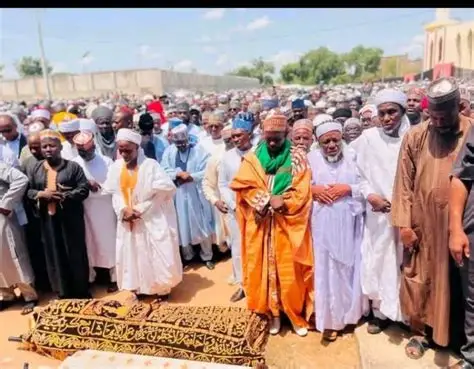
The family has announced that Tukur will be laid to rest on Sunday, September 13, 2026, in accordance with Islamic rites. The current state is that the elder statesman has been laid to rest, at the time of filing this report.
Funeral prayers, or Janazah, were scheduled for 10:00 a.m. at the Palace of the Lamido of Adamawa in Yola, after which the remains were interred.
The burial attracted political leaders, government officials, traditional rulers, businessmen, associates and other dignitaries from across Nigeria and beyond, reflecting the breadth of Tukur’s public and private-sector career.
ADAMAWA DECLARES THREE DAYS OF MOURNING
Governor Fintiri has declared three days of mourning across Adamawa State in honour of the late elder statesman.
During the mourning period, government flags across the state are to fly at half-mast as a mark of respect for the former governor and one of Adamawa’s most prominent sons. Fintiri described Tukur as a colossus whose contributions to Adamawa State and Nigeria earned him a permanent place in the nation’s history.
The governor said he would personally miss Tukur’s counsel and experience, while extending condolences to the family and all those affected by the loss.
A LIFE THAT CUT ACROSS NIGERIA’S POLITICAL AND ECONOMIC HISTORY
Tukur’s death brings to an end a remarkable career spanning maritime administration, state governance, federal public service, private enterprise, African economic diplomacy and partisan politics.
Born on September 15, 1935, Tukur first achieved national prominence in the 1970s when he became General Manager and Chief Executive of the Nigerian Ports Authority (NPA), a position he held from 1975 to 1982.
His period at the NPA coincided with a critical phase in the development of Nigeria’s maritime economy. He was involved in efforts to modernise port operations and expand the country’s capacity to handle growing maritime trade.
His career subsequently moved into politics.
In 1983, Tukur was elected Governor of the old Gongola State, which comprised what are today Adamawa and Taraba states. His administration, however, was cut short by the military coup that ended the Second Republic later that year.
He later returned to national public service and served as Minister of Industries from 1993 to 1995 under the administration of former military Head of State, General Sani Abacha.
BUSINESSMAN AND PAN-AFRICAN ECONOMIC ADVOCATE
Away from government, Tukur established himself as an influential businessman and industrialist.
He founded BHI Holdings, also known as the DADDO Group of Companies, with interests extending across areas including manufacturing, agriculture, logistics and trading.
His influence also extended to the continental business community.
Tukur served as Executive President of the African Business Roundtable and Chairman of the NEPAD Business Group, participating in efforts to strengthen African private-sector development, trade, investment and economic cooperation.
The African Business Roundtable still identifies him as its Grand Patron, while the organisation has described his leadership and vision as foundational to its continuing mission of advancing Africa’s private-sector development.
FROM WADATA PLAZA TO THE PDP NATIONAL CHAIRMANSHIP
Tukur returned to the centre of Nigerian partisan politics in March 2012, when he became National Chairman of the Peoples Democratic Party.
At the time, the PDP was Nigeria’s ruling party, and its national secretariat at Wadata Plaza, Abuja, was one of the most powerful political centres in the country.
He remained chairman until January 2014, when he resigned following a period of intense internal crisis within the party. His tenure coincided with one of the most turbulent periods in the PDP’s history, including the emergence of a breakaway faction of the party in 2013.
Despite the controversies that accompanied his period as party chairman, his broader career remained much larger than his time in partisan politics.
He had already served Nigeria in several capacities before arriving at Wadata Plaza and had built a reputation across government, business and African economic institutions.
TINUBU, FINTIRI AND NIGERIA MOURN
President Bola Ahmed Tinubu described Tukur’s death as the end of a significant chapter in Nigeria’s political and economic history.
According to the President, Tukur was a towering figure whose career encompassed public administration, governance, industry, politics and Pan-African business leadership.
Tinubu described him as a man of ideas and enterprise who believed strongly in Nigeria’s potential and said the country would miss his wise counsel and fatherly guidance.
Governor Fintiri similarly described the death as a monumental loss, stressing Tukur’s wealth of experience, wisdom and commitment to public service.
The PDP has also mourned its former national chairman, remembering him as an administrator, businessman, politician and committed party member whose career contributed significantly to Nigeria’s political history.
A GENERATION LOSING ONE OF ITS GIANTS
The death of Bamanga Tukur represents more than the passing of a former governor or former political party chairman.
It is the departure of a member of a generation that occupied important positions during several defining periods of Nigeria’s political and economic evolution.
From the Nigerian Ports Authority to the Gongola State Government House; from the Federal Executive Council to African business institutions; and from the corridors of industry to the PDP national secretariat, Tukur’s career reflected the changing face of Nigeria over several decades.
His traditional title of Tafidan Adamawa further reflected his standing within the social and traditional structure of his home state.
He was also a recipient of the national honour of Commander of the Order of the Niger (CON).
Tukur is survived by two wives and 18 children, among them Awwal Tukur, the Secretary to the Government of Adamawa State.
As Adamawa prepares to lay him to rest, the arrival of his remains in Yola on Saturday night has brought the state’s mourning into its final phase.
On Sunday, September 13, 2026, at 10:00 a.m., family, friends, political associates, traditional authorities and dignitaries will gather at the Lamido’s Palace for the final prayers.
Then, in accordance with Islamic tradition, Bamanga Tukur will return to the earth of the state he once governed — leaving behind a legacy that stretches across Nigeria’s maritime, political, business and Pan-African history.
#BamangaTukur #Adamawa #PDP #Nigeria #AWCNews


