


AWC STATEHOUSE DESK
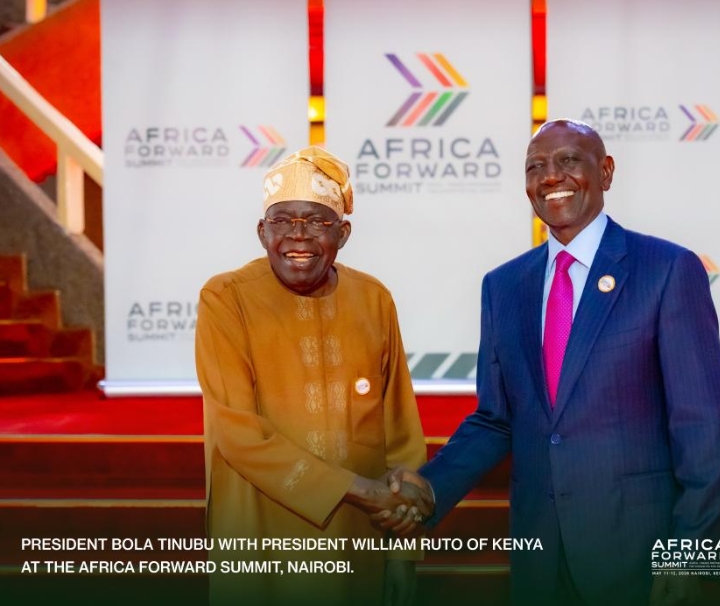
May, 2026 – President Bola Ahmed Tinubu on Tuesday led Nigeria’s high-powered delegation to the Africa Forward Summit in Nairobi, Kenya, where he called for stronger African economic integration, enhanced maritime security, and urgent reforms of the global financial architecture to support industrialisation and sustainable growth across the continent.
The summit, jointly hosted by Kenyan President William Ruto and French President Emmanuel Macron, brought together Heads of State, top government officials, global investors, development institutions, and business leaders from more than 30 countries.
Also delivering keynote remarks at the summit were António Guterres and Mahamoud Ali Youssouf, who both stressed the need for stronger international cooperation, climate resilience, and inclusive economic growth across Africa.
Speaking during a major policy session at the Kenyatta International Convention Centre (KICC), President Tinubu outlined Nigeria’s vision for Africa’s economic transformation, insisting that African nations must move beyond dependence on raw material exports and pursue industrialisation, regional integration, and financial independence.
The Nigerian leader highlighted the country’s blue economy strategy as a key pillar of continental development, noting that insecurity and uncertainty had historically limited investment in Africa’s maritime sector.
According to him, Nigeria is now prepared to intensify regional maritime coordination by deploying the country’s Deep Blue Project infrastructure as a shared intelligence and security platform for willing Gulf of Guinea nations.
“Secure sea lanes, predictable regulation, and functional courts are the preconditions that unlock private capital,” Tinubu stated, adding that governance reforms and maritime security initiatives were already repositioning Nigeria as an attractive investment destination in the marine and logistics sectors.
The President further argued that Africa’s economic future depended on transforming the continent’s oceans and waterways from zones of insecurity into engines of commerce, trade, and regional prosperity.
On international finance and development, Tinubu mounted a strong case for reform of global lending systems, accusing existing financial structures of frustrating Africa’s industrial ambitions through high borrowing costs and restrictive credit conditions.
He noted that despite years of independence, Africa still accounts for less than two per cent of global manufacturing value-added, largely because of limited access to affordable capital and persistent illicit financial flows.
The President defended Nigeria’s ongoing economic reforms, including fuel subsidy removal, exchange rate unification, banking sector recapitalisation, and efforts to strengthen fiscal discipline.
Tinubu disclosed that Nigeria’s debt-to-GDP ratio is projected at about 32.3 per cent in 2026, while external reserves have risen to approximately $45.5 billion, developments he said reflected renewed investor confidence in the Nigerian economy.
However, he warned that Africa continues to face punitive borrowing conditions that weaken industrial growth and reduce governments’ ability to invest in infrastructure, manufacturing, power generation, and job creation.
“Every single dollar that leaves our treasury to pay punitive interest rates is a dollar that did not go into our steel sector, our textile mills, our agro-processing plants, or our digital industries,” the President said.
Tinubu also addressed migration and security concerns, stressing that irregular migration from Africa would only reduce when governments and development partners invest meaningfully in jobs, energy access, climate adaptation, agriculture, and digital innovation.
He called for stronger global cooperation on migration governance and urged development partners to allocate more funding to programmes capable of addressing poverty, unemployment, and insecurity across Africa.
On the sidelines of the summit, President Tinubu held bilateral discussions with Michael Randrianirina to strengthen diplomatic and economic ties between Nigeria and Madagascar.
The Nigerian leader also met with Patrice Motsepe, where he reaffirmed Nigeria’s readiness to host the 2026 CAF Awards.
Nigeria’s delegation to the summit included the Minister of Foreign Affairs, Bianca Odumegwu-Ojukwu; Minister of Agriculture and Food Security, Abubakar Kyari; Minister of Marine and Blue Economy, Adegboyega Oyetola; Minister of Environment, Balarabe Abbas Lawal; Minister of Industry, Trade and Investment, Jumoke Oduwole; and Minister of Communications, Innovation and Digital Economy, Bosun Tijani.
Leading members of Nigeria’s private sector were also present, including Aliko Dangote, Abdul Samad Rabiu, Tony Elumelu and Aigboje Aig-Imoukhuede.
The summit featured extensive discussions on artificial intelligence, digital transformation, climate financing, agriculture, manufacturing, intra-African trade under the African Continental Free Trade Area (AfCFTA), youth entrepreneurship, healthcare innovation, and regional infrastructure development.
Analysts say President Tinubu’s intervention at the summit reflects Nigeria’s attempt to position itself as a leading voice in ongoing debates around African industrialisation, maritime security, and reforms of global financial institutions amid increasing competition for influence on the continent.


