


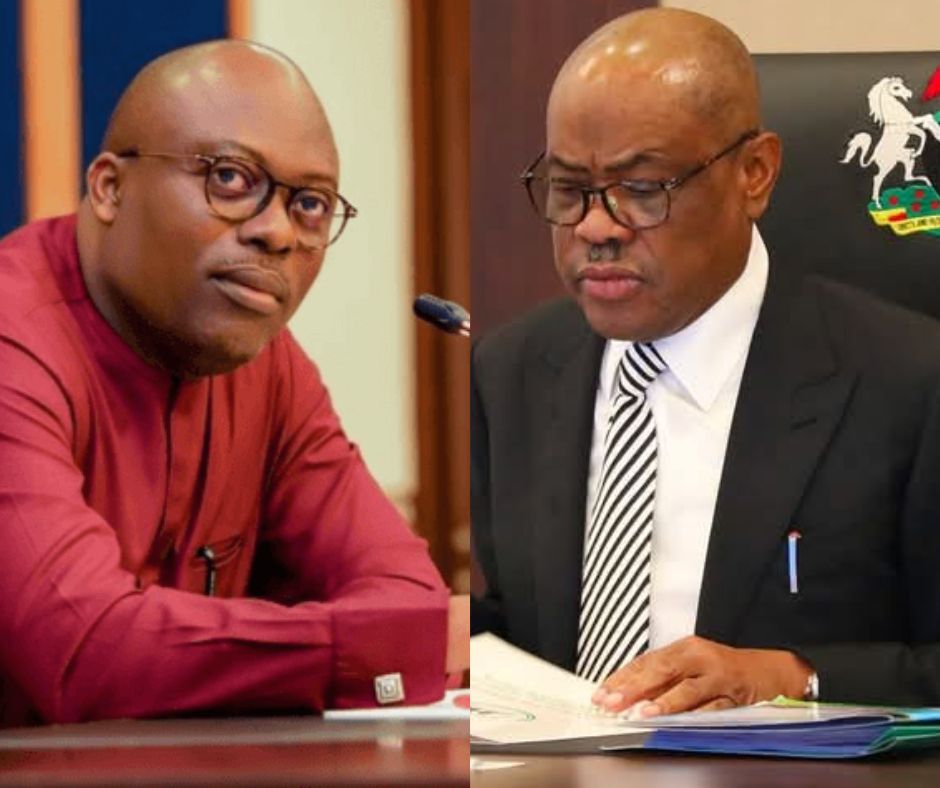
…From the Assembly power struggle to emergency rule and the 2027 withdrawal, has Siminalayi Fubara surrendered too much political ground?
By Amah Alphonsus Amaonye, Director General, African Writers Centre, AWC.
The political career of Rivers State Governor, Siminalayi Fubara, has entered one of its most uncertain phases, raising a fundamental question about the consequences of taking on a powerful political structure without first securing the institutional and political machinery necessary to sustain the fight.
Fubara’s dramatic political journey began with his bitter fallout with his predecessor and political benefactor, Nyesom Wike. What started as a disagreement over political influence and control of the machinery of government eventually became an open confrontation involving the Rivers State House of Assembly, impeachment threats, court battles and, ultimately, federal intervention.
The first major weakness exposed by the crisis was the governor’s inability to consolidate control of the State House of Assembly.
Lawmakers regarded as loyal to Wike became the principal counterweight to the governor. The legislature eventually fractured into rival camps, with Martin Amaewhule emerging as the leader of the group backed by Wike. The conflict became so severe that impeachment proceedings were repeatedly initiated against Fubara.
The political question therefore became simple but consequential: if the governor could not control the legislature, could he nevertheless build a sufficiently strong political coalition to neutralise the influence of his predecessor?
The answer, at least for much of the crisis, appeared uncertain.
THE FIGHT FUBARA STARTED BUT COULD NOT FINISH
Fubara did not merely inherit a political disagreement. He entered into an open struggle for control of Rivers State’s political structure.
His supporters argued that he was fighting for the independence of an elected governor to govern without interference from a predecessor. Wike and his supporters, on the other hand, accused Fubara of betrayal and reneging on political understandings between them.
The confrontation produced enormous political costs.
The House of Assembly was divided. Government operations were disrupted. Impeachment proceedings became a recurring threat. Court cases multiplied. Political appointments became contentious. And eventually, the crisis escalated beyond the capacity of the two camps to resolve it themselves.
That culminated in President Bola Tinubu’s declaration of a state of emergency in Rivers State on March 18, 2025.
Fubara, his deputy and members of the State House of Assembly were suspended, while retired Vice Admiral Ibok-Ete Ibas was appointed administrator. The action generated substantial constitutional controversy, with the Nigerian Bar Association among those who questioned the suspension of elected officials.
WHEN THE PRESIDENTIAL HAMMER FELL
This was arguably the most dramatic moment of Fubara’s political career.
A sitting governor who had engaged his predecessor in an intense struggle for political control suddenly found himself outside Government House.
It is important, however, to state the record accurately: Fubara did not simply surrender his office permanently. The emergency rule lasted six months, after which President Tinubu lifted it and Fubara returned to office in September 2025.
There were legal challenges surrounding the emergency rule. A Federal High Court later dismissed a suit challenging the suspension, holding that it lacked jurisdiction over the validity of the presidential proclamation and stating that the matter fell within the exclusive jurisdiction of the Supreme Court.
Nevertheless, politically, the episode demonstrated the extraordinary extent to which the Rivers crisis had escaped the control of the governor and his immediate political camp.
THE FINAL RETREAT: 2027
The most consequential development came in May 2026.
After entering the APC governorship process, Fubara withdrew from the party’s governorship primary. In his public explanation, he said he was putting peace, stability and the unity of Rivers State above personal ambition and pledged to support whoever emerged as the party’s candidate. He explicitly rejected the interpretation that his withdrawal represented weakness, fear or surrender.
But politics is ultimately judged not only by the explanation offered by politicians, but also by the consequences of their decisions.
And the consequence is striking.
The incumbent governor will not be contesting the 2027 governorship election.
Instead, Fubara subsequently aligned himself with the political coalition led by Wike and, in July, publicly endorsed Kingsley Chinda as his preferred governorship candidate for Rivers State. He also urged his supporters to support the coalition’s candidates.
This represents an extraordinary reversal of political circumstances.
A governor who once appeared determined to wrest political control from Wike eventually returned to the political family from which the confrontation began.
FROM CONFRONTATION TO RECONCILIATION
That reversal is the central issue in assessing Fubara’s political legacy.
Was the governor outmanoeuvred?
Did he realise that the political structure confronting him was too deeply entrenched to defeat through direct confrontation?
Or did he deliberately choose political accommodation after concluding that Rivers State had paid too high a price for the prolonged struggle?
Those questions remain matters of political interpretation.
What is established, however, is that the confrontation ended not with Fubara controlling the political structure he had fought to reclaim, but with him withdrawing from the 2027 governorship contest and later supporting a candidate identified with the broader Wike-backed political coalition.
THE QUESTION OF POLITICAL CAPACITY
This is where the harshest criticism of Fubara is likely to emerge.
Critics may argue that he entered a political war without adequately calculating the strength of his opponent, the composition of the legislature, the loyalty networks embedded within the state party structure and the wider political alliances available to Wike.
In that interpretation, the governor had the constitutional powers of the office but did not possess sufficient political machinery to translate those powers into sustained political control.
That distinction matters.
Political office and political power are not always the same thing.
A governor may occupy Government House while another political actor controls a substantial portion of the party structure, legislators, local networks and political alliances.
The Rivers crisis became a powerful illustration of that distinction.
FUBARA’S POLITICAL FUTURE
For Fubara, the question now is no longer simply whether he will return to Government House after 2027. His tenure is constitutionally approaching its end, and he has removed himself from the immediate contest for succession.
His political future is consequently uncertain.
There have even been misleading claims that he had emerged as the YPP governorship candidate. Africa Check reported on September 24 that the YPP candidate is Blessing Fubara Snr, not Governor Siminalayi Fubara.
Meanwhile, Fubara’s endorsement of Chinda has placed him within the same political coalition that emerged from his reconciliation with Wike.
That raises perhaps the most intriguing question of all:
After fighting to escape Wike’s political shadow, has Fubara ultimately returned to it?
The answer will depend not simply on what happens in the 2027 election, but on whether Fubara can retain an independent political identity and influence after leaving office.
THE VERDICT OF POLITICAL HISTORY
It would be premature to describe Fubara as politically finished.
He remains the sitting governor of Rivers State as of September 2026, and his political decisions may yet produce another chapter.
But the record of the past three years presents a difficult political narrative: confrontation with Wike, a divided legislature, repeated impeachment threats, emergency rule, political reconciliation, withdrawal from the 2027 governorship contest and eventual endorsement of a candidate associated with the Wike-led coalition.
For his critics, that sequence represents a retreat from a battle that he began without sufficient political preparation.
For his supporters, it represents the difficult price of choosing peace over personal ambition.
History will ultimately determine which interpretation carries greater weight.
For now, however, one fact is difficult to ignore:
Siminalayi Fubara entered the Rivers political crisis seeking greater political independence from Nyesom Wike. He has emerged from the confrontation without the 2027 governorship ticket—and now publicly supporting a successor from the political coalition led by the man with whom he once fought.
That is not necessarily political defeat.
But it is unquestionably one of the most dramatic reversals in Nigeria’s contemporary state-level politics.
#RiversPolitics #SiminalayiFubara #NyesomWike #Rivers2027 #NigeriaPolitics


