


By Amah Alphonsus Amaonye
Is tension rising again between the United States and North Korea?
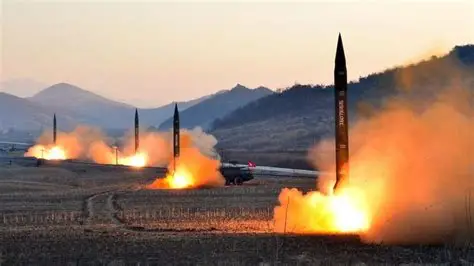
That question is gaining urgency after North Korea launched two missiles toward the sea off its eastern coast on Sunday, September 20, in the latest in a series of weapons demonstrations that have followed U.S.-led military exercises in the region.
South Korea’s military said the two launches occurred about three hours apart from the Wonsan area.
The first missile travelled approximately 450 kilometres, while the second flew more than 600 kilometres, before both fell into waters off North Korea’s eastern coast. South Korean and U.S. authorities were analysing the precise specifications of the weapons.
The launches marked North Korea’s second round of missile tests in roughly a week, adding to concerns about another cycle of military pressure and counter-pressure on the Korean Peninsula.
A FAMILIAR PATTERN: DRILLS, WARNINGS AND MISSILES
The latest launches did not occur in isolation.
On September 12, North Korea fired multiple ballistic missiles from the Wonsan area, one day after the United States, South Korea and Japan concluded the five-day Freedom Edge military exercise.
The North had already condemned the exercise and warned that it could take what it described as strong countermeasures against military provocations.
North Korea has also criticised another U.S.-led multinational naval exercise, Pacific Vanguard.
On September 18, Kim Yo Jong, the influential sister of North Korean leader Kim Jong Un, described U.S.-led military exercises as a major source of worsening tensions on the peninsula and said Pyongyang would continue strengthening its nuclear deterrent.
That warning was followed just two days later by Sunday’s missile launches.
WASHINGTON AND ITS ALLIES SEE IT DIFFERENTLY
From the American and allied perspective, the military exercises are designed to maintain readiness against North Korea’s nuclear and missile capabilities.
The United States, South Korea and Japan have repeatedly stressed cooperation in responding to Pyongyang’s weapons programme.
The September Freedom Edge exercise was specifically designed to test readiness against North Korea’s missile and nuclear threats.
But Pyongyang views such exercises very differently.
North Korea has consistently described U.S.-led military activity around the peninsula as threatening and provocative, arguing that the drills amount to preparations for confrontation.
This creates a dangerous security dilemma:
Washington and its allies say they are conducting exercises because North Korea is a threat; North Korea says it is developing and testing weapons because Washington and its allies are a threat.
Each side’s military preparations consequently become evidence for the other side’s argument.
TRUMP HAS ALREADY TRIED TO REDUCE THE TEMPERATURE
The latest developments are particularly noteworthy because U.S. President Donald Trump has previously taken steps aimed at reducing military pressure.
Trump scaled back a major joint exercise with South Korea and cancelled another planned Marine Corps exercise, partly arguing that large exercises could send the wrong message to North Korea.
He has also expressed interest in another meeting with Kim Jong Un, following their previous encounters in 2018 and 2019.
Yet North Korea has continued its weapons demonstrations.
That suggests that reducing the scale of exercises alone has not produced an immediate return to dialogue.
IS THIS AN ESCALATION?
There are certainly signs of heightened military signalling.
North Korea has conducted repeated missile tests.
Its leadership is warning that its nuclear deterrent will continue to expand.
The United States, South Korea and Japan are maintaining joint military readiness.
And the rhetoric from Pyongyang has become increasingly critical of U.S.-led military activity.
But there is an important distinction between rising tension and imminent war.
Sunday’s missiles were short-range weapons fired into the sea. South Korea said they did not strike its territory, while Japan reported that the first missile fell outside its exclusive economic zone.
There is therefore no evidence from Sunday’s launches alone of an immediate move toward direct U.S.-North Korean military confrontation.
THE DIPLOMATIC DOOR IS NOT COMPLETELY CLOSED
The most significant uncertainty may be what happens next.
North Korea has demonstrated that it can combine military pressure with political messaging. Washington has indicated an interest in renewed engagement, while South Korea has continued to support dialogue alongside maintaining its military readiness.
But Pyongyang’s insistence on strengthening its nuclear capabilities remains a major obstacle.
The result is an increasingly familiar cycle:
military exercises → North Korean warnings → missile tests → allied condemnation and heightened readiness → further North Korean warnings.
The longer that cycle continues, the greater the risk of miscalculation.
THE QUESTION FOR THE WORLD
So, is tension rising between the United States and North Korea?
The latest evidence points to heightened military and rhetorical tension, particularly around exercises, missile tests and North Korea’s nuclear deterrence programme.
But whether that tension develops into a broader confrontation remains uncertain.
For now, the Korean Peninsula is witnessing another dangerous exchange of signals—Washington and its allies demonstrating readiness, Pyongyang demonstrating weapons capability, and both sides insisting that the other is responsible for the rising pressure.
The immediate challenge for diplomacy is therefore not simply stopping the next missile launch.
It is breaking the cycle in which one side’s attempt at deterrence becomes the other side’s justification for escalation.
And with North Korea launching two missiles in a single afternoon, that cycle appears far from over.
#NorthKorea #UnitedStates #KoreanPeninsula #KimJongUn #WorldNews


