


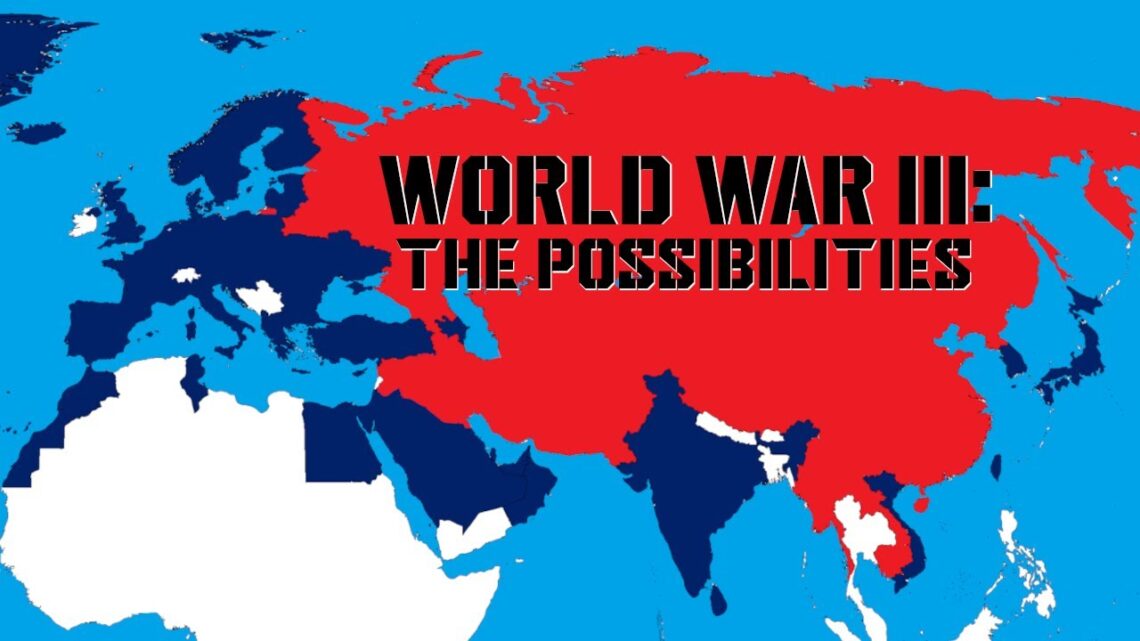
AWC FOREIGN DESK, SEPTEMBER 2026
THE WORLD IS NOT AT WAR YET—BUT THE PIECES ARE MOVING.
From Ukraine to Iran, Taiwan to the Korean Peninsula, rival powers are pushing red lines that could turn separate conflicts into one global confrontation.
The world is entering one of the most dangerous geopolitical periods in decades.
Across Europe, the Middle East and the Indo-Pacific, military confrontation, proxy warfare, drone attacks, cyber operations, sanctions, nuclear deterrence and increasingly aggressive rhetoric are converging in ways that could produce an unintended chain reaction.
There is no evidence that the United States, Russia, China, Iran, Israel, North Korea or Europe has a coordinated plan to start a Third World War.
But that may not be the most frightening possibility.
The greater danger is that separate conflicts could collide through miscalculation, retaliation or alliance commitments, creating a war that none of the principal actors originally intended.
That is how the world should understand the current danger.
1. THE UNITED STATES AND IRAN: THE MIDDLE EASTERN FIRE THAT COULD SPREAD
The most immediate flashpoint is the confrontation between the United States and Iran, with Israel deeply involved.
The conflict has already gone beyond rhetoric. US and Israeli military action against Iran has been followed by Iranian retaliation against American positions and regional targets. Recent fighting has included attacks connected to shipping and the strategically vital Strait of Hormuz, raising concerns about global energy supplies.
This creates an extraordinary escalation ladder.
An Iranian attack on an American installation could trigger a larger US response.
A larger US response could provoke Iran to attack American forces or allies.
Israel could become involved more deeply.
Iran-aligned armed groups could expand the conflict across the Middle East.
And an attack on commercial shipping through the Strait of Hormuz could transform a regional war into a global economic crisis.
The danger is not simply the weapons being fired.
It is what happens after the next retaliation.
2. ISRAEL: SECURITY DOCTRINE MEETS REGIONAL ESCALATION
Israel faces multiple security challenges simultaneously—from Iran and Hezbollah to armed groups in Gaza and elsewhere in the region.
Israel’s leadership has demonstrated a willingness to use overwhelming military force when it believes an existential threat is developing.
That strategy may strengthen deterrence in some circumstances, but it also creates the possibility of escalation.
The danger is particularly acute where Israel’s security calculations intersect with American military power.
If Israel launches an operation that triggers a major Iranian response, Washington could be drawn further into the conflict.
At that point, the confrontation would no longer be simply an Israel-Iran conflict.
It would become an increasingly direct US-Iran war, with consequences extending across the Gulf, Europe and Asia.
3. RUSSIA AND UKRAINE: THE MOST DANGEROUS EUROPEAN FRONT
The Russia-Ukraine war remains perhaps the most obvious pathway to a direct confrontation between Russia and NATO.
Russia continues its war against Ukraine, while European states continue supporting Kyiv.
The danger lies in the growing geographical reach of the conflict.
Russian drones and other alleged hybrid operations have increasingly become a concern for European governments. A recent drone incident at Leipzig/Halle Airport in Germany has intensified accusations between Moscow and Berlin, with Russian Foreign Minister Sergei Lavrov describing Western accusations of Russian involvement as an attempt to start a “real war.”
This is precisely the kind of situation that worries strategists.
A drone incident.
A misidentified aircraft.
A strike crossing a border.
A cyberattack on critical infrastructure.
A NATO aircraft being hit.
A Russian missile accidentally killing civilians in a NATO country.
Any one of these could create enormous pressure on European governments to respond.
And once NATO and Russia begin exchanging fire directly, the world’s most powerful nuclear alliance would be confronting a nuclear-armed Russia.
4. UKRAINE: THE WAR THAT COULD PULL NATO DIRECTLY INTO COMBAT
Ukraine itself has become a battlefield where increasingly sophisticated weapons are being employed against Russia.
Kyiv has demonstrated an ability to strike targets deep inside Russian territory, while Moscow continues missile and drone attacks against Ukrainian cities and infrastructure.
Russian President Vladimir Putin recently claimed that Russia is advancing and rejected Ukrainian leadership as a legitimate negotiating partner, although he indicated openness to substantive discussions involving US representatives.
The longer the war continues, the greater the possibility of an accident or deliberate escalation involving NATO territory.
The fundamental question is:
How far can Western military support for Ukraine go before Moscow regards the West as a direct belligerent?
That boundary is becoming increasingly difficult to define.
5. CHINA: THE TAIWAN QUESTION
Then there is China.
The Taiwan Strait represents perhaps the most consequential potential US-China military flashpoint.
Beijing considers Taiwan part of China and has repeatedly refused to rule out the use of force to achieve unification.
Washington maintains a longstanding policy of supporting Taiwan while deliberately preserving strategic ambiguity about exactly how it would respond to an attack.
That ambiguity is designed to deter both Beijing and Taipei from taking actions that could trigger war.
But ambiguity can become dangerous if either side miscalculates.
A Chinese military blockade or invasion of Taiwan would almost certainly create enormous pressure on the United States to respond.
And a US military intervention against China would create a conflict between the world’s two most powerful economies and militaries.
The consequences would extend far beyond East Asia.
Global semiconductor supplies, shipping routes, financial markets and international trade could be thrown into chaos.
6. NORTH KOREA: THE UNPREDICTABLE NUCLEAR VARIABLE
North Korea adds another dangerous dimension.
Pyongyang possesses nuclear weapons and ballistic missiles and has increasingly aligned itself with Russia.
The war in Ukraine has also reinforced North Korea’s argument that nuclear weapons provide the ultimate guarantee against regime change, according to analysts.
The danger on the Korean Peninsula is that a relatively small military incident could escalate rapidly.
An artillery exchange.
A missile test gone wrong.
A naval confrontation.
An attack on South Korean territory.
Or a mistaken interpretation of military exercises.
South Korea is backed by the United States.
North Korea has a growing strategic relationship with Russia.
China remains North Korea’s most important economic and geopolitical partner.
A Korean conflict could therefore quickly acquire a much larger international dimension.
7. RUSSIA, CHINA, IRAN AND NORTH KOREA: IS A NEW BLOC EMERGING?
It would be an oversimplification to describe Russia, China, Iran and North Korea as a formal military alliance equivalent to NATO.
They have different interests and do not necessarily trust one another.
But their increasing cooperation is significant.
Russia has deepened relationships with Iran and North Korea, while China has expanded strategic competition with the United States.
This creates a geopolitical environment in which pressure on one country can affect the calculations of another.
The United States therefore faces not one strategic competitor but a collection of governments whose interests sometimes converge around opposition to American power.
That does not mean they will fight together.
But it means that one crisis could create opportunities or incentives for another actor to open a second front elsewhere.
That is one of the scenarios that makes today’s geopolitical environment particularly dangerous.
8. EUROPE IS REARMING
Europe is also changing.
The Ukraine war has shattered many European assumptions about the post-Cold War security environment.
European governments are increasing defence spending, strengthening military capabilities and preparing for the possibility of a prolonged confrontation with Russia.
The European Union and NATO are simultaneously attempting to deter Moscow while avoiding direct war.
But deterrence is a delicate game.
The stronger Europe becomes militarily, the more credible its deterrent may be.
Yet the more military forces operate close to Russia, the greater the potential for an accident or miscalculation.
Europe therefore faces an uncomfortable paradox:
It must prepare for war in order to prevent war.
9. THE MOST DANGEROUS WEAPON MAY BE MISCALCULATION
The world does not necessarily need a leader who deliberately wants World War III.
It could happen through a chain of decisions.
Imagine:
Russia attacks a NATO target → NATO retaliates → Russia strikes a European military base → the United States reinforces Europe → China exploits the distraction around Taiwan → North Korea launches a provocation → Iran attacks US interests in the Middle East → Israel expands its campaign → Russia or China provides additional military assistance.
That sequence is hypothetical.
But the underlying principle is real:
Modern conflicts are interconnected.
Analysts have warned against casually describing every current conflict as World War III, noting that today’s wars overlap and interact without necessarily converging into one global war.
That distinction is crucial.
The world is not necessarily heading inevitably toward a third world war.
But there are now more pathways toward unintended great-power confrontation than existed for many years.
10. THE NUCLEAR QUESTION
The ultimate danger is nuclear escalation.
Russia possesses one of the world’s largest nuclear arsenals.
The United States possesses an enormous nuclear arsenal.
China is expanding its nuclear capability.
North Korea possesses nuclear weapons.
Israel is widely believed to possess nuclear weapons, although it maintains a policy of nuclear ambiguity.
That means several of the countries involved in today’s strategic confrontations possess weapons capable of causing catastrophic destruction.
The existence of nuclear weapons has historically created a powerful incentive for caution.
But nuclear deterrence depends upon rational decision-making, reliable communications and accurate information.
Cyberattacks, misinformation, artificial intelligence, satellite warfare and increasingly rapid missile systems could make decision-making even more difficult during a crisis.
The greatest danger may therefore be not a deliberate decision to launch a nuclear war, but a mistaken belief that an adversary has already launched one.
11. WHAT COULD ACTUALLY TRIGGER A WORLD WAR?
Several events deserve particular attention:
1. A direct NATO-Russia military clash.
2. A Chinese blockade or invasion of Taiwan.
3. A major Iranian attack on US forces or Gulf shipping.
4. An Israeli-Iranian escalation that pulls the United States into a wider regional war.
5. A North Korean attack on South Korea or Japan.
6. A major cyberattack on critical infrastructure attributed to a nuclear-armed state.
7. A military accident involving US, Russian or Chinese forces.
8. A miscalculation caused by false intelligence or misinformation.
Any of these could create a crisis in which leaders face enormous domestic and military pressure to retaliate.
THE WORLD’S MOST DANGEROUS MOMENT MAY BE THE MOMENT AFTER THE ATTACK
History repeatedly demonstrates that wars do not always develop according to the intentions of the people who start them.
Leaders believe they can control escalation.
They assume their opponent will back down.
They underestimate the enemy.
They misread intelligence.
They make threats that subsequently become difficult to withdraw.
And eventually, events begin controlling the leaders.
That is the danger facing the world today.
The United States wants deterrence.
Russia wants strategic depth and recognition of its interests.
Ukraine wants sovereignty and security.
Israel wants security against existential threats.
Iran wants regime survival and regional influence.
China wants control over what it considers its territory and greater strategic influence.
North Korea wants regime survival and nuclear deterrence.
Europe wants protection from Russian aggression without becoming the battlefield of a new continental war.
None necessarily requires World War III.
Yet their competing objectives are producing an increasingly crowded geopolitical battlefield.
CONCLUSION: THE WORLD NEEDS OFF-RAMPS, NOT MORE RED LINES
The most dangerous misconception would be to assume that because nobody wants World War III, it cannot happen.
World wars are often born from interlocking crises, alliance commitments, miscalculations and retaliatory decisions.
The present international system contains all four ingredients.
But there is another possibility.
Diplomacy can still prevail.
The United States and China can maintain military communication.
Russia and NATO can establish mechanisms to prevent accidental confrontation.
Ukraine and Russia can eventually return to meaningful negotiations.
The United States, Israel and Iran can establish channels capable of preventing further escalation.
China and Taiwan can avoid irreversible provocations.
The Korean Peninsula can remain under deterrence rather than descend into war.
The choice before the international community is therefore not simply war or peace.
It is whether governments will continue pushing their adversaries toward the edge of the cliff—or begin building enough off-ramps to ensure that one mistake does not become humanity’s next catastrophe.
The world is not condemned to another world war.
But the margin for error is becoming dangerously thin.
#WorldWarIII #GeopoliticalCrisis #GlobalSecurity #NATO #WorldPolitics


