


AWC Economy Desk
Nigeria has renewed its call for a more assertive, balanced, and choice-driven South-South cooperation framework, urging developing economies to move beyond dependency and ideological rivalry toward practical partnerships that deliver shared prosperity.
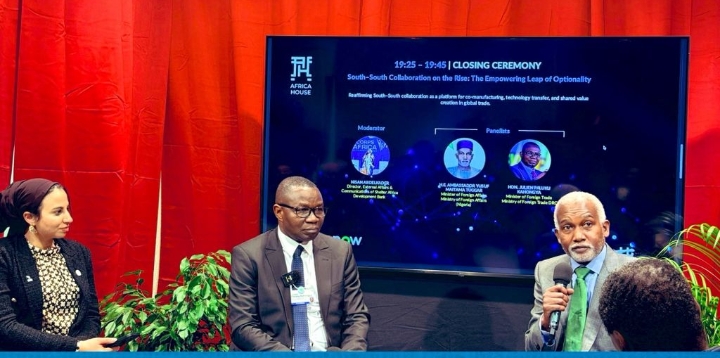
This position was articulated by the Minister of Foreign Affairs, Hon. Yusuf Maitama Tuggar, at the closing ceremony of Africa House during the World Economic Forum (WEF), held on 21 January 2026, under the theme “South-South Collaboration on the Rise: The Empowering Leap of Optionality.”
Speaking to policymakers, business leaders, and development partners, Tuggar emphasized that Nigeria’s foreign policy is anchored on strategic autonomy, balance, and optionality—the ability of nations to choose partnerships that align with their long-term development interests rather than being drawn into zero-sum geopolitical contests or resource-driven rivalries.
He stressed that Africa’s future lies in cooperation over competition, noting that the continent’s challenge is not a lack of wealth but the need to process, add value, and scale production. According to him, this transformation must be driven by a capable private sector, supported by strong Regional Economic Communities and enabling policy frameworks.
The Minister highlighted Nigeria’s commitment to deepening South-South partnerships through platforms such as the African Continental Free Trade Area (AfCFTA), ZOPACAS, and expanding Africa-Asia economic linkages, all aimed at strengthening industrial policies, developing regional value chains, and accelerating production-led growth across the Global South.
He noted that such collaboration offers African and developing economies the leverage to negotiate from a position of strength, diversify partnerships, and build resilient economies that can compete globally.
The closing ceremony marked a high point of Africa House at WEF, reinforcing a growing consensus that South-South collaboration—grounded in choice, capacity, and value creation—will be central to shaping the next phase of global economic engagement.