


AWC Education Desk
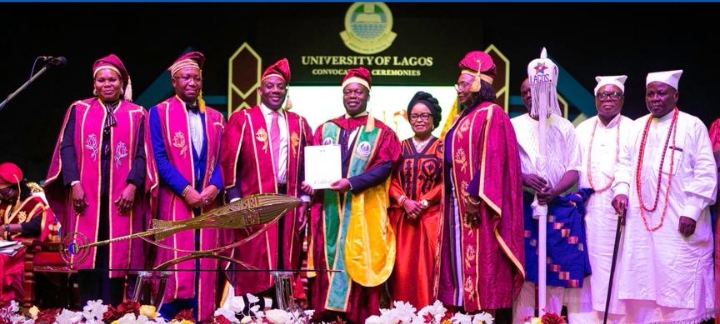
The Federal Government has used the 56th Convocation Ceremony of the University of Lagos (UNILAG) to underscore measurable progress in Nigeria’s education reforms, positioning the sector as a key performance pillar of the Renewed Hope Agenda and a critical driver of national renewal.
Speaking on behalf of President Bola Ahmed Tinubu, GCFR, the Minister of Education, Dr. Tunji Alausa, CON, told graduates, parents, academics, and stakeholders that public expectations of improved access, quality, and relevance in higher education are increasingly being matched by policy actions and funding commitments.
From a performance and accountability standpoint, Dr. Alausa pointed to the ₦161.9 billion disbursed through the Nigerian Education Loan Fund (NELFUND) as a major intervention easing financial pressure on students and families, while expanding access to tertiary education. He noted that the scale of the intervention reflects a shift from rhetoric to results-driven governance in the education sector.
The Minister also highlighted sustained investments in university infrastructure, including upgraded lecture theatres, hostels, medical schools, simulation laboratories, and research facilities, largely supported through enhanced TETFund allocations. These interventions, he said, are designed to directly improve learning conditions and institutional competitiveness—benchmarks increasingly used by the public to assess government performance.
In response to growing societal demand for employable skills, Dr. Alausa emphasized the rollout of the Entrepreneurship, Innovation and Business Incubation Certification (EIBIC) programme, aimed at equipping graduates with enterprise and problem-solving skills beyond traditional academic training. He stressed that employability outcomes, not just graduation numbers, now define success in tertiary education policy.
Looking ahead, the Minister announced plans to upgrade 46 innovation and technology hubs nationwide in 2026, with a strong focus on artificial intelligence, digital skills, and emerging technologies. This, he said, aligns with public expectations that Nigerian graduates must be globally competitive and capable of driving a knowledge-based economy.
Addressing the graduating class, Dr. Alausa charged them to see their degrees not merely as personal achievements but as tools for national service, innovation, and economic transformation. He reaffirmed the Federal Government’s commitment to policy consistency, funding sustainability, and performance monitoring as the education sector continues to evolve.
The UNILAG convocation, attended by stakeholders from across academia and government, provided a public platform for assessing education reforms not just by promises made, but by investments delivered and outcomes expected—placing the sector firmly under the lens of national performance indices.