


AWC Statehouse Desk
The National Economic Council (NEC) has set a decisive tone for Nigeria’s economic direction in 2026, resolving to intensify stakeholder engagement and accelerate the transition from an oil-dependent economy to a diversified, non-oil growth model.
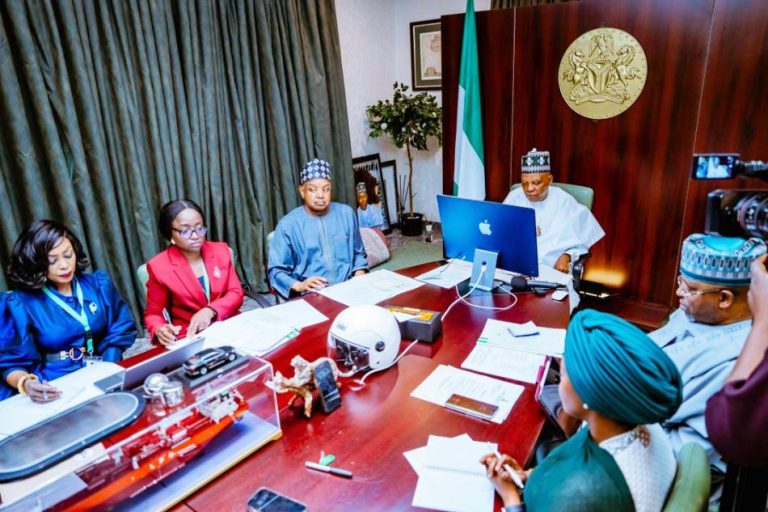
At its 156th meeting—the first of the year—held virtually on Thursday, the Council, chaired by Vice President Kashim Shettima, endorsed measures aimed at boosting non-oil revenues in line with President Bola Ahmed Tinubu’s economic blueprint and Renewed Hope Agenda.
Addressing the Council, Vice President Shettima stressed the urgency of reducing Nigeria’s exposure to volatile oil markets through competitive manufacturing, export diversification and increased private sector investment. He noted that agriculture, services and other non-oil sectors now account for about 96 per cent of Nigeria’s GDP, contributing nearly three-quarters of total government revenues.
“The non-oil economy has emerged as the backbone of Nigeria’s growth story,” Shettima said, adding that while the economy expanded by 3.9 per cent in 2025, faster growth is required to significantly reduce poverty, create jobs and improve living standards.
The Council also approved the constitution of a Presidential NEC Committee on Legacy Projects, chaired by the Governor of Cross River State, with governors from Sokoto, Gombe, Niger, Abia and Lagos representing the six geopolitical zones. The committee will oversee the implementation of major infrastructure projects, including the Lagos–Calabar Coastal Highway and the Sokoto–Badagry Super Highway.
Minister of Finance and Coordinating Minister of the Economy, Mr. Wale Edun, presented the administration’s economic priorities for 2026, highlighting reforms that have stabilised the economy, restored investor confidence and positioned Nigeria for projected growth of 4.68 per cent this year. Key priorities include food affordability, human capital development, social protection, and timely payment of salaries, pensions and debt obligations.
NEC commended the Federal Government’s plans to unlock job-rich growth and resolved to dedicate a special session to address pressing food security and agricultural productivity challenges.
In other deliberations, the Council received updates on national accounts, including balances in the Excess Crude Account, Stabilisation Account and Natural Resources Account. It also reviewed progress on tax reforms aimed at fixing inequities, simplifying the tax system and promoting shared prosperity, directing further engagement with states ahead of a major NEC conference in February.
The Council further welcomed the World Bank–Nigeria Country Partnership Framework, which prioritises human capital development, early childhood investment and result-based national programmes implemented at state level.
Concluding the meeting, NEC reaffirmed its commitment to working closely with states, development partners and the private sector to deliver sustained, inclusive growth and reposition Nigeria as a resilient, competitive, non-oil-driven economy.