


AWC Statehouse Desk
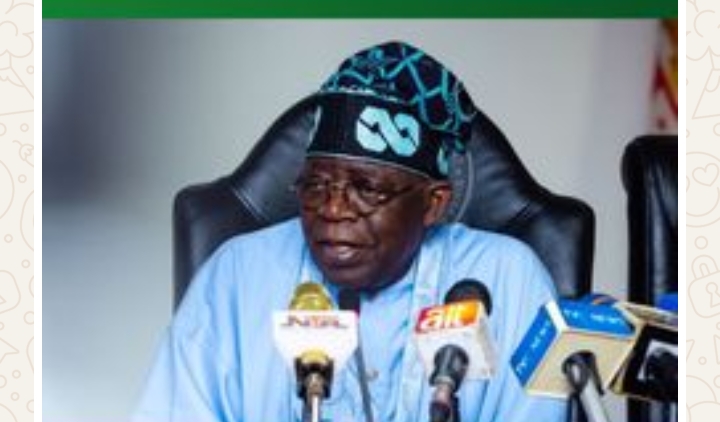
President Bola Ahmed Tinubu has hailed the Nigerian Exchange (NGX) for crossing the historic N100 trillion market capitalisation milestone, describing the feat as a defining moment in Nigeria’s economic resurgence and a strong signal of renewed investor confidence.
In a statement on Thursday, January 8, 2026, President Tinubu commended corporate Nigeria, market operators and citizens for their collective role in achieving the landmark, which he said marks the birth of a “new economic reality and rejuvenation” for the country.
The President noted that the NGX’s performance in 2025 stood out globally, even as many international markets struggled with stagnation. He disclosed that the NGX All-Share Index closed 2025 with an impressive 51.19 per cent return, surpassing the 37.65 per cent recorded in 2024 and outperforming major global indices such as the S&P 500, FTSE 100 and several emerging markets within the BRICS+ group.
“Nigeria is no longer a frontier market to be ignored; it is now a compelling destination where value is being discovered,” Tinubu said, stressing that the strong showing of the stock market reflects broader economic health and growing investor trust in the Nigerian economy.
He highlighted remarkable performances across all sectors on the Exchange, from industrial giants that have localised supply chains to a resilient and technologically innovative banking sector, noting that Nigerian companies are proving their capacity to deliver strong returns on investment.
President Tinubu also revealed that the pipeline of new listings remains robust, with indigenous energy firms, tech unicorns, telecoms companies and infrastructure-heavy entities preparing to access the capital market to fund expansion. According to him, these listings will further boost market capitalisation and deepen democratic ownership of the economy.
Beyond the capital market, the President pointed to improving macroeconomic indicators driven by ongoing reforms. He disclosed that inflation has steadily declined from a 24-month high of 34.8 per cent in December 2024 to 14.45 per cent as of November 2025, with projections indicating a further drop to about 12 per cent in 2026 and possibly below 10 per cent before the end of the year.
He attributed the progress to monetary tightening, the removal of distortionary Ways and Means financing, increased agricultural investment and improved naira stability.
On external balances, Tinubu said Nigeria recorded a $16 billion current account surplus in 2024, with projections by the Central Bank of Nigeria (CBN) putting the figure at $18.81 billion in 2026. He added that non-oil exports surged by 48 per cent to N9.2 trillion by the third quarter of 2025, while exports to Africa jumped by 97 per cent to N4.9 trillion. Manufacturing exports also grew by 67 per cent year-on-year in the second quarter of 2025.
The President further disclosed that foreign reserves have crossed $45 billion and are projected to exceed $50 billion in the first quarter of 2026, providing greater stability for the naira.
Highlighting gains in infrastructure and social sectors, Tinubu cited expanded rail networks, major road projects, revitalised ports, improved healthcare facilities, declining medical tourism costs, enhanced university research funding and increased access to education through the Nigeria Education Loan Fund (NELFUND).
“Nation-building is a process, not a destination. The N100 trillion market capitalisation is a signal to the world that the Nigerian economy is robust and productive,” the President said, pledging to continue driving an egalitarian, transparent and high-growth economy anchored on historic tax and fiscal reforms that took effect on January 1.
He urged Nigerians to deepen their investments in the local economy, assuring them that 2026 promises to be an epochal year of shared prosperity as reforms deliver stronger and more inclusive outcomes.